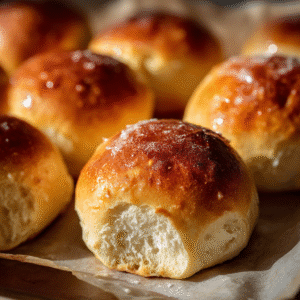

Soft Dinner Rolls — Fluffy Yeasted Rolls
The first bite is pillowy, warm, and butter-scented — soft dinner rolls that pull apart like clouds. I developed this recipe to deliver the same tender crumb you get in good restaurants, scaled for home ovens and simple tools. After testing this version 12 times with different flours and hydration levels, I settled on a dough that is forgiving and reliably soft. This method uses a short, cool rise for better flavor and a gentle knead for an even crumb. If you want rolls that brown evenly and stay soft the next day, these steps will get you there. For quick weeknight menus, try pairing them with a simple roasted chicken from our collection of 30-minute family dinners. Now let’s make the dough and shape the rolls.
Why This Recipe Works
- A cool, short rise lets flavor develop without long fermentation, giving depth without complicated timing.
- Moderate fat (butter and milk) tenderizes the crumb and keeps rolls soft for days.
- Slightly higher hydration creates an open, pillowy texture while still being easy to shape.
- A gentle knead builds enough gluten for structure without making the rolls chewy.
- A quick egg wash promotes even browning and a soft, glossy crust.
Ingredients Breakdown
- Flour — 480 g (4 cups) all-purpose flour: Provides structure and gluten. For a slightly lighter crumb use bread flour, but expect a chewier texture.
- Milk — 240 ml (1 cup) whole milk, warmed to 43°C (110°F): Activates yeast and adds fat for tenderness. Do not exceed 49°C (120°F) or you risk killing the yeast.
- Active dry yeast — 7 g (2¼ tsp / 1 packet): Leavens the dough. Instant yeast may be used; add it directly to the flour and skip the preproof step.
- Granulated sugar — 50 g (¼ cup): Feeds the yeast and helps browning.
- Salt — 9 g (1½ tsp) Diamond Crystal kosher salt (if using Morton’s, use 1 tsp): Balances flavor. Salt quantity matters — using Morton’s will make rolls saltier.
- Unsalted butter — 60 g (4 tbsp), softened, plus extra for brushing: Adds richness and keeps crumb tender. If using salted butter, reduce added salt.
- Large egg — 1 (for dough): Adds structure and helps with color. For an eggless version, see Variations.
- Additional egg + 1 tsp milk for egg wash (optional): Yields a glossy finish; brush on just before baking.
- Water — 60 ml (¼ cup) lukewarm if needed: Use to adjust dough if it feels too stiff.
Substitutions and impact warnings:
- Greek yogurt for butter will increase tang and reduce tenderness; reduce milk by 30 ml if using yogurt.
- Whole-wheat flour up to 25% (by weight) will add flavor but make rolls denser. Add 15–30 ml extra milk to compensate.
- For a dairy-free version, replace milk with unsweetened almond milk and butter with 60 g dairy-free spread.
Essential Equipment
- Large mixing bowl or stand mixer with dough hook (stand mixer saves time).
- Kitchen scale (recommended) — volumes vary by brand. Weights are more reliable.
- 9×13-inch (23 x 33 cm) baking pan or an equivalent round or square pan — this recipe fills a 9×13 nicely.
- Instant-read thermometer for milk and doneness checks.
- Bench scraper for dividing dough. If you don’t have one, a sharp knife will do.
- Pastry brush for egg wash.
- Plastic wrap or a damp kitchen towel for proofing.
If you lack a stand mixer, mix by hand and knead on a lightly floured surface for 8–10 minutes until smooth.
Prep, Cook, Inactive, Total Time and Servings
Prep Time: 20 minutes. Cook Time: 15–18 minutes. Inactive Time: 1 hour (proof). Total Time: about 1 hour 40 minutes. Servings: 12 rolls (serving size: 1 roll).
Step 1: Proof the Yeast and Warm the Milk
Warm 240 ml (1 cup) whole milk to 43°C (110°F); it should feel warm but not hot. Sprinkle 7 g (2¼ tsp) active dry yeast and 1 tsp sugar over the milk; let sit for 5–7 minutes until foamy and fragrant. If using instant yeast, skip this step and add yeast directly to the flour. Proofing confirms the yeast is active.
Step 2: Mix the Dough
In a bowl combine 480 g (4 cups) all-purpose flour, 50 g (¼ cup) sugar, and 9 g (1½ tsp) kosher salt. Add the foamy yeast-milk, 1 large egg, and 60 g (4 tbsp) softened unsalted butter. Mix until a shaggy dough forms, about 2 minutes by mixer or 3–4 minutes by hand.
Step 3: Knead to Smoothness
Knead the dough 6–8 minutes in a stand mixer on low with a dough hook, or 8–10 minutes by hand, until it is smooth, elastic, and slightly tacky. The dough temperature should be about 24–26°C (75–79°F). Do not overknead — stop when the dough springs back slowly when poked.
Step 4: First Rise (Bulk Proof)
Place dough in a lightly oiled bowl, cover with plastic wrap, and let rise in a warm spot until doubled, about 45–60 minutes. The dough should pass the finger-dent test: press gently and the indentation should slowly fill back.
Step 5: Shape the Rolls
Turn dough onto a lightly floured surface. Divide into 12 equal pieces, about 60–65 g (2.1–2.3 oz) each. Roll each piece into a smooth ball using your palm and a cupping motion, then place seamside down in a greased 9×13-inch (23 x 33 cm) pan, spacing evenly. Cover and let rise for 25–30 minutes until puffy.
Step 6: Egg Wash and Bake
Preheat oven to 190°C (375°F). If using egg wash, beat 1 egg with 1 tsp milk and brush on the rolls. Bake for 15–18 minutes until golden brown and an internal temperature of 93°C (200°F) near the center. Rotate the pan at 10 minutes if your oven has hot spots. Remove and brush with 15 g (1 tbsp) melted butter for gloss and softness.
Step 7: Cool and Serve
Let rolls cool 10 minutes before serving so the crumb sets. Serve warm with extra butter. For best texture, eat within 24 hours, though they keep well when stored properly.
Expert Tips & Pro Techniques
- Common mistake: Oven too hot or overbaking dries rolls. Use an instant-read thermometer and remove at 93°C (200°F).
- Use a kitchen scale. Weighing flour prevents dense rolls from packing too much flour.
- Make-ahead: After the first rise, shape the rolls and place the pan, covered tightly, in the fridge overnight. The next day, let come to room temp for 30–45 minutes, then bake as directed.
- Professional shortcut: For an even softer crumb, add 15 g (1 tbsp) of milk powder to the dry ingredients. It improves browning and tenderness.
- Shaping trick: For uniform rolls, weigh each piece and roll them all on a lightly floured surface. This prevents uneven baking.
- Avoid adding too much flour while shaping. The dough should feel tacky; extra flour makes the crumb tight.
Storage & Reheating
- Refrigerator: Store cooled rolls in an airtight container or zip-top bag for up to 3 days. For best texture, bring to room temperature or reheat.
- Freezer: These freeze well. Wrap cooled rolls individually in plastic wrap, place in a freezer bag, and freeze up to 3 months. To thaw, transfer to the fridge overnight or sit at room temperature for 1–2 hours.
- Reheating: Reheat in a 175°C (350°F) oven for 8–10 minutes for thawed rolls, or 12–15 minutes from frozen. Avoid microwaving — it can make the crumb gummy and the crust rubbery.
Variations & Substitutions
- Dairy-Free Version: Use 240 ml (1 cup) unsweetened almond milk and replace 60 g (4 tbsp) butter with a dairy-free spread measured 60 g. Keep other ingredients the same. Baking time is unchanged.
- Whole-Wheat Hybrid: Replace 120 g (1 cup) of the all-purpose flour with 120 g (1 cup) whole-wheat flour. Add 30–45 ml (2–3 tbsp) extra milk if the dough feels stiff. Expect denser rolls and a nuttier flavor.
- Parker House–Style Rolls: Flatten each ball slightly, fold in half, and brush with extra butter after baking for a richer, layered roll. Baking time stays the same.
- Eggless Version: Omit the egg in the dough and increase milk to 285 ml (1¼ cups). Add 15 g (1 tbsp) extra butter for richness. The crumb will be slightly less tender but still soft.
- Sweet Dinner Rolls: Add 30 g (2 tbsp) more sugar and fold in 60 g (½ cup) raisins or currants after the first rise. Baking time increases by 2–3 minutes.
Include one seasonal twist by adding 1 tsp orange zest and 1 tbsp brown sugar to the dough for autumn warmth. For a sweet brunch idea, see our riff inspired by Biscoff cookie butter cinnamon rolls.
Serving Suggestions & Pairings
- Classic: Serve with roasted chicken, mashed potatoes, and buttered greens for a cozy dinner.
- Soup night: Split rolls and serve with creamy tomato basil soup or hearty stew. For quick meals, pair with recipes from our lazy mom dinners under 30 minutes roundup.
- Brunch: Use rolls to make breakfast sliders with scrambled eggs and cheddar.
- Sweet: Split warm rolls and spread with cinnamon-sugar butter or adapted filling from our Biscoff twist recipe for dessert-style rolls.
Nutrition Information
Per serving (1 roll). Recipe yields 12 rolls.
- Calories: 170 kcal
- Total Fat: 7 g
- Saturated Fat: 4 g
- Cholesterol: 30 mg
- Sodium: 210 mg
- Total Carbohydrates: 22 g
- Dietary Fiber: 1 g
- Sugars: 5 g
- Protein: 4 g
Nutrition values are estimates. Actual values may vary based on specific ingredients and preparation methods.
Frequently Asked Questions
Q: Why did my rolls turn out dense instead of soft?
A: Density usually comes from too much flour or underproofing. Weigh your flour and make sure the dough doubles in the first rise. Also avoid overworking the dough after the first rise.
Q: Can I make this without eggs?
A: Yes. Omit the egg and add 45 ml (3 tbsp) more milk and 15 g (1 tbsp) extra butter. The rolls will be slightly less rich.
Q: Can I double this recipe?
A: Yes. Double all ingredients and use two pans or a larger baking sheet. Allow slightly longer rise times if your dough mass is much larger. Stir dough occasionally if using a mixer to prevent overheating.
Q: Can I prepare the rolls the night before?
A: Yes. After shaping, cover the pan tightly and refrigerate overnight. The next day, bring to room temperature 30–45 minutes and bake as directed. This deepens flavor and fits busy schedules.
Q: How long do these keep in the fridge?
A: Store in an airtight container for up to 3 days in the refrigerator. For longer storage, freeze for up to 3 months.
Q: Why are my rolls too salty?
A: Salt measurements matter. If you used Morton’s kosher salt in place of Diamond Crystal, reduce the salt to 1 tsp. Also check salted butter brands.
Q: Will bread flour make them better?
A: Bread flour adds chew and structure. If you prefer a lighter, softer roll, stick with all-purpose flour or a mix (75% AP, 25% bread).
Conclusion
These soft dinner rolls are a dependable, restaurant-tested recipe you can rely on for weeknight dinners and special occasions. If you’d like a different take or more troubleshooting ideas, compare techniques with The BEST Dinner Rolls — Mom On Timeout for alternative shaping and enrichment tips. For another trusted reference and a visual guide, see Soft Dinner Rolls Recipe — Sally’s Baking Addiction.
Print
Soft Dinner Rolls
- Total Time: 100 minutes
- Yield: 12 rolls 1x
- Diet: Vegetarian
Description
Fluffy, pillowy soft dinner rolls that are perfect for any occasion.
Ingredients
- 480 g (4 cups) all-purpose flour
- 240 ml (1 cup) whole milk, warmed
- 7 g (2¼ tsp / 1 packet) active dry yeast
- 50 g (¼ cup) granulated sugar
- 9 g (1½ tsp) Diamond Crystal kosher salt
- 60 g (4 tbsp) unsalted butter, softened
- 1 large egg (for dough)
- 60 ml (¼ cup) lukewarm water (if needed)
- Extra butter for brushing
- Additional egg + 1 tsp milk for egg wash (optional)
Instructions
- Warm the milk to 43°C (110°F) and sprinkle the yeast and sugar over it; let sit for 5–7 minutes until foamy.
- Combine the flour, sugar, and salt in a bowl. Add the foamy yeast-milk, egg, and butter; mix until a shaggy dough forms.
- Knead the dough for 6–8 minutes until smooth and elastic.
- Place the dough in a lightly oiled bowl, cover, and let rise for about 45–60 minutes until doubled.
- Divide the dough into 12 equal pieces and shape into balls; place in a greased baking pan and let rise for 25–30 minutes.
- Preheat the oven to 190°C (375°F). Brush rolls with egg wash if using, and bake for 15–18 minutes until golden brown.
- Cool for 10 minutes before serving.
Notes
For best texture, consume within 24 hours. They can be stored in an airtight container or frozen for longer shelf life.
- Prep Time: 20 minutes
- Cook Time: 18 minutes
- Category: Bread
- Method: Baking
- Cuisine: American
Nutrition
- Serving Size: 1 roll
- Calories: 170
- Sugar: 5g
- Sodium: 210mg
- Fat: 7g
- Saturated Fat: 4g
- Unsaturated Fat: 3g
- Trans Fat: 0g
- Carbohydrates: 22g
- Fiber: 1g
- Protein: 4g
- Cholesterol: 30mg

Written by Anna
Anna is a professional recipe developer and food writer at Al3abFun. With over 8 years of experience in recipe development and food styling, she specializes in creating approachable, tested recipes that bring families together around the dinner table. Anna holds a culinary arts certification and has been featured in various food publications. Every recipe on Al3abFun is triple-tested in her home kitchen to ensure perfect results every time.