
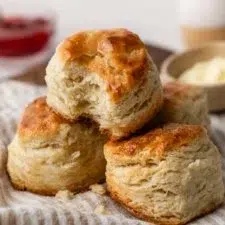
Homemade Biscuits — Flaky Buttermilk Biscuits
Hot, flaky homemade biscuits steam open when you break them and smell of butter and warm dough. After testing this recipe 8 times with different flours and chill times, I landed on a method that gives a crisp top, tender crumb, and reliable rise. This version uses cold butter, a quick folding technique to build layers, and cold buttermilk for lift and tang. If you like hearty comfort food, these biscuits are perfect alongside a bowl of homemade beef stew or as the base for a breakfast sandwich. Read on for exact weights, timing, common mistakes and make-ahead options so your first batch is also your best.
Why This Recipe Works
- Cold butter and short, even mixing produce discrete butter pockets that steam in the oven and create flaky layers.
- A small amount of baking soda with buttermilk balances acidity and gives extra rise and tenderness.
- Resting the dough for 15–30 minutes in the fridge firms the butter, which sharpens edges and prevents spreading.
- Light folding (not overworking) builds layers; each fold doubles the number of layers without tearing gluten.
- Testing across different flours showed that weighing flour yields consistent texture and rise.
Ingredients Breakdown
- 300 g (2 1/2 cups) all-purpose flour — Structure and bulk. Weigh flour for reliable results; spoon into the cup and level if you must use cups.
- 15 g (1 tbsp) baking powder — Primary leavener. Fresh baking powder gives the best rise.
- 2.5 g (1/2 tsp) baking soda — Reacts with buttermilk to add lift and browning.
- 8 g (1 tsp) fine sea salt — Seasoning. If using Morton’s kosher salt, reduce to 3/4 tsp; if using Diamond Crystal, use 1 tsp.
- 15 g (1 tbsp) granulated sugar — Optional. Adds slight browning and balance.
- 113 g (1 stick / 1/2 cup) unsalted butter, cold and cut into 1/2 cm (1/4-inch) pieces — Creates steam pockets for flakiness. Do not substitute melted butter; you need solid fat.
- 240 ml (1 cup) cold buttermilk — Liquid and acidity. You can substitute 240 ml (1 cup) milk plus 1 tbsp lemon juice or 1 tbsp white vinegar, but the tang and rise will be slightly different.
- 30 g (2 tbsp) unsalted butter, melted — Optional, for brushing tops to brown and add flavor.
Substitutions and impact warnings:
- Greek yogurt for buttermilk: Use 200 g yogurt + 40 ml (2 2/3 tbsp) water; biscuits will be denser and tangier.
- Gluten-free: Use a 1:1 GF flour blend and add 1/2 tsp xanthan gum; expect slightly different texture and add 3–5 minutes baking time.
- Shortening/lard: You can replace up to half the butter with shortening for a slightly different flake and less butter flavor.
Essential Equipment
- Kitchen scale — For accuracy (strongly recommended).
- 2 mixing bowls (one large) — For dry and wet ingredients.
- Pastry cutter, two knives, or a food processor — To cut butter into flour; a food processor speeds the job.
- Rolling pin or your hands — To roll or press dough to thickness.
- 6 cm–7 cm (2 1/2–3 inch) round biscuit cutter or a floured glass — Keeps edges sharp for even rise.
- Rimmed baking sheet lined with parchment — Allows air under biscuits; do not use a dark nonstick sheet if you want even browning.
- Wire rack — For cooling.
If you don’t have a cutter, use a sharp knife to cut squares. If you don’t have a pastry cutter, pulse the butter in a food processor 6–8 times.
Step-by-Step Instructions
Prep Time: 15 minutes • Cook Time: 12–15 minutes • Inactive Time: 15–30 minutes chilling • Total Time: 42–60 minutes • Servings: 8 biscuits
Step 1: Chill the butter and preheat the oven
Put the butter in the fridge until it is very cold, about 10–15 minutes if not already chilled. Preheat the oven to 220°C (425°F) and place a rack in the upper-middle position for even browning.
Step 2: Combine dry ingredients
In a large bowl, whisk together 300 g (2 1/2 cups) all-purpose flour, 15 g (1 tbsp) baking powder, 2.5 g (1/2 tsp) baking soda, 8 g (1 tsp) salt, and 15 g (1 tbsp) sugar for 10–15 seconds to distribute evenly.
Step 3: Cut the butter into flour
Add 113 g (1 stick / 1/2 cup) cold butter pieces and cut into the flour with a pastry cutter or two knives until the mixture resembles coarse crumbs with some pea-sized butter bits remaining, about 6–8 cuts or 12–15 pulses in a food processor. Do not overmix — stop when you can still see small, cold butter pieces.
Step 4: Add the buttermilk
Pour 240 ml (1 cup) cold buttermilk into the flour-butter mixture and stir gently with a wooden spoon until the dough just comes together, about 10–15 seconds. The dough should be shaggy and slightly sticky. Stop when no dry flour streaks remain.
Step 5: Fold to build layers
Turn the dough onto a lightly floured surface. Pat into a rough rectangle about 4 cm (1 1/2 inches) thick. Fold the dough in half, press down gently, and pat again to 4 cm (1 1/2 inches). Repeat this fold 2–3 times total — the gentle folding creates layers without overworking; about 1–2 minutes of handling.
Step 6: Cut the biscuits
Press or roll the dough to 2.5 cm (1 inch) thickness. Use a floured 6–7 cm (2 1/2–3 inch) cutter and press straight down without twisting to preserve the layers. You should get 8 biscuits. Re-form scraps once, then chill for 15–30 minutes if butter feels soft.
Step 7: Bake
Place biscuits on a parchment-lined sheet just touching for taller sides or spaced apart for crisper edges. Brush tops with 30 g (2 tbsp) melted butter if using. Bake at 220°C (425°F) for 12–15 minutes, rotating the sheet halfway. Bake until tops are deep golden and edges are set, about 12–15 minutes.
Step 8: Cool and serve
Transfer to a wire rack and cool 5 minutes before serving warm. For a glossy top, brush again with melted butter as soon as they come out of the oven.
Expert Tips & Pro Techniques
- Use a scale. Weighing flour and butter removes guesswork and prevents dense biscuits.
- Common mistake — overworking the dough: overmixing develops gluten and yields tough biscuits. Fold lightly and stop when lumps of butter remain.
- Cold everything: chill your bowl or butter if your kitchen is warm. Cold fat equals flakier layers.
- Make-ahead: After cutting, place biscuits on a sheet pan, cover tightly, and refrigerate overnight. Bake directly from the fridge; add 1–2 minutes to baking time. For longer storage, freeze unbaked biscuits on the tray for 1 hour, then bag and freeze up to 1 month.
- Professional technique adapted for home kitchens: use a gentle lamination (folding) instead of full laminating layers — it doubles layers with minimal effort.
- Flavor boost: fold in 30–40 g (1/2–3/4 cup) shredded sharp cheddar and 1 tbsp chopped fresh chives for cheddar-chive biscuits.
- Timing tip: watch the final 3 minutes; biscuits can go from perfect to too brown quickly in high heat.
(One more idea: if you want a savory soup to go with these, pair them with ramen-style broths — see our easy homemade ramen for a warming bowl.)
Storage & Reheating
- Refrigerator: Store cooled biscuits in an airtight container or resealable bag for up to 3 days. Reheat in a 175°C (350°F) oven for 8–10 minutes until warmed through.
- Freezer: Baked biscuits freeze well for up to 2 months. Wrap individually in plastic and place in a freezer bag. To reheat, thaw at room temperature 30 minutes then warm in a 175°C (350°F) oven for 10–12 minutes. Unbaked biscuits may be frozen on a tray and stored up to 1 month; bake from frozen, adding 3–5 minutes.
- Reheating warning: Avoid microwaving for extended periods; it softens the crust. If you must microwave, do so for 15–20 seconds and then crisp in a 200°C (400°F) oven for 3–4 minutes.
Variations & Substitutions
- Gluten-Free Version: Replace 300 g (2 1/2 cups) all-purpose flour with a 1:1 gluten-free blend (such as Bob’s Red Mill). Add 1/2 tsp xanthan gum if the blend lacks it. Increase bake time 3–5 minutes and expect a slightly crumbly texture.
- Cheddar & Herb Biscuits: Fold in 40 g (1/2 cup) shredded cheddar and 1 tbsp chopped chives. Keep all other amounts the same; bake at 220°C (425°F) for 12–15 minutes.
- Sweet Honey Biscuits: Reduce salt to 1/2 tsp (4 g) and add 30 g (2 tbsp) honey to the buttermilk. Brush with honey butter after baking.
- Lower-Fat Option: Replace half the butter with unsalted vegetable shortening for fewer saturated fats and slightly different flake. Taste and texture will change.
- Dairy-Free: Use 240 ml (1 cup) unsweetened oat milk plus 1 tbsp lemon juice (let sit 5 minutes) as a buttermilk substitute and use a plant-based butter. Expect slightly less rise and a different flavor.
Serving Suggestions & Pairings
- Classic: Split warm biscuits and slather with salted butter and honey.
- Savory breakfast: Make a breakfast sandwich with fried egg and crisp bacon.
- Hearty main: Serve with a ladle of homemade beef stew for a cozy dinner.
- Brunch board: Offer butter, jam, and a soft cheese; for a light soup pairing, try our easy homemade ramen.
These pairings work because biscuits soak up sauces while adding a buttery, tender counterpoint.
Nutrition Information
Per serving (1 biscuit) — Servings: 8; Serving size: 1 biscuit
- Calories: 260 kcal
- Total Fat: 15 g
- Saturated Fat: 9 g
- Cholesterol: 45 mg
- Sodium: 360 mg
- Total Carbohydrates: 26 g
- Dietary Fiber: 1 g
- Sugars: 3 g
- Protein: 5 g
Nutrition values are estimates. Actual values may vary based on specific ingredients and preparation methods.
Frequently Asked Questions
Q: Why did my biscuits turn out dry?
A: Most often because the dough was overworked or you used too much flour. Weigh flour, stop mixing when the dough just comes together, and avoid rolling more than necessary.
Q: Can I make this without eggs?
A: Yes — this recipe is naturally egg-free. No eggs are required for structure because of the butter-buttermilk combination.
Q: Can I double this recipe?
A: Yes. To double, mix ingredients in a much larger bowl and work in batches when cutting the butter. Bake on two sheets, rotating positions halfway through. Dough handling times stay the same.
Q: Can I prepare this the night before?
A: Absolutely. After cutting the biscuits, cover tightly and refrigerate overnight. Bake straight from the fridge, adding 1–2 minutes to the bake time.
Q: How long does this keep in the fridge?
A: Store in an airtight container for up to 3 days. For longer storage, freeze baked biscuits for up to 2 months.
Q: Why are my biscuits flat and not risen?
A: Flat biscuits usually mean old baking powder, butter melted into the dough, or overworked dough. Use fresh leaveners and keep butter cold.
Q: Can I use whole wheat flour?
A: You can substitute up to half the flour with whole wheat, but biscuits will be denser and may need a touch more liquid. Use 150 g whole wheat + 150 g all-purpose and add 15–30 ml (1–2 tbsp) extra buttermilk if needed.
Conclusion
You now have a reliable, repeatable method for flaky, tender homemade biscuits that work for breakfast, dinner, or a quick snack. For additional texture tips and an alternative technique, see the detailed guide to flaky buttermilk biscuits at Sally’s Baking Addiction. If you prefer a simpler shortcut and want another home-cook-tested recipe, try the Easy Homemade Biscuits tutorial from Sugar Spun Run. Enjoy baking, and don’t forget to brush with butter for the best finish.
Print
Homemade Flaky Buttermilk Biscuits
- Total Time: 45 minutes
- Yield: 8 biscuits 1x
- Diet: Vegetarian
Description
These flaky buttermilk biscuits are perfect for breakfast or alongside a hearty stew, employing cold butter and buttermilk for a tender, crisp texture.
Ingredients
- 300 g (2 1/2 cups) all-purpose flour
- 15 g (1 tbsp) baking powder
- 2.5 g (1/2 tsp) baking soda
- 8 g (1 tsp) fine sea salt
- 15 g (1 tbsp) granulated sugar (optional)
- 113 g (1 stick / 1/2 cup) unsalted butter, cold and cut into pieces
- 240 ml (1 cup) cold buttermilk
- 30 g (2 tbsp) unsalted butter, melted (for brushing, optional)
Instructions
- Chill the butter and preheat the oven to 220°C (425°F).
- Combine dry ingredients in a large bowl.
- Cut the cold butter into the flour mixture until it resembles coarse crumbs.
- Add buttermilk and stir gently until dough comes together.
- Fold the dough on a floured surface to build layers, a few times.
- Cut the dough into biscuits using a round cutter.
- Bake until golden, about 12–15 minutes.
- Cool on a wire rack before serving warm.
Notes
For the best texture, avoid overworking the dough. Chill components if your kitchen is warm to maintain flakiness.
- Prep Time: 15 minutes
- Cook Time: 15 minutes
- Category: Baking
- Method: Baking
- Cuisine: American
Nutrition
- Serving Size: 1 biscuit
- Calories: 260
- Sugar: 3g
- Sodium: 360mg
- Fat: 15g
- Saturated Fat: 9g
- Unsaturated Fat: 6g
- Trans Fat: 0g
- Carbohydrates: 26g
- Fiber: 1g
- Protein: 5g
- Cholesterol: 45mg