
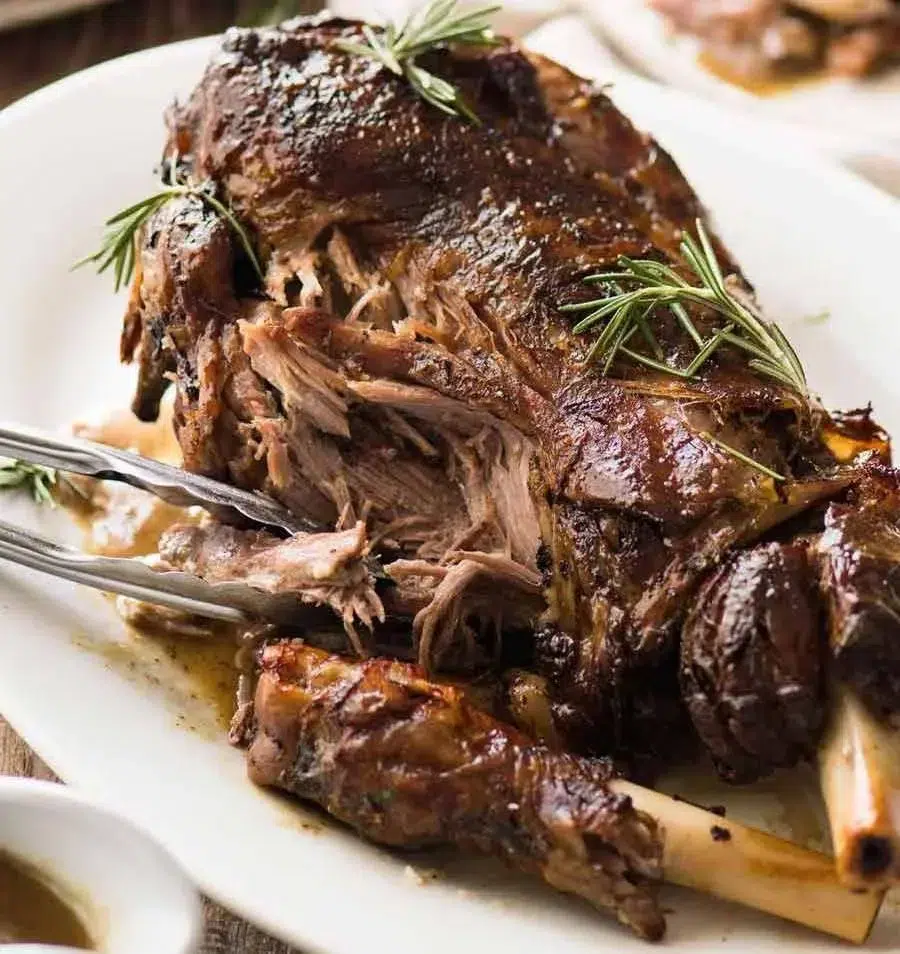
Slow Roast Leg of Lamb — Tender, Juicy Roast
The oven fills the house with warm, herbal steam while the meat melts into tender, sliceable perfection — this slow roast leg of lamb is a showstopper. After testing and refining this method during my years in professional kitchens and repeating it 10 times at home, I settled on low heat, a tight herb crust, and a final blast of high heat to crisp the outside while keeping the inside rosy. The slow, gentle cook makes the lamb forgiving and flavorful, so it’s ideal for a holiday or a relaxed Sunday dinner. Read on for clear steps, exact timings, and the small tricks that make this approach reliable, whether you’re serving eight or prepping a feast ahead of time.
Why this recipe works
- Low-and-slow cooking breaks down connective tissue in the leg, producing tender, fork‑tender meat without drying the roast.
- A salt-and-herb rub seasons deeply; resting the rubbed joint in the fridge lets flavors penetrate and dries the surface for a better crust.
- The final high-heat blast recreates a roast’s classic crust without overcooking the center.
- Spiking the pan juices with a splash of vinegar or wine brightens rich lamb flavors and creates a quick pan sauce.
- Tested across different leg sizes to keep timing consistent and safe: internal temperature is the primary doneness cue.
Ingredients breakdown
- Leg of lamb, bone-in, 2.5 kg (5.5 lb): The classic choice. Bone-in roasts carry more flavor and cook more evenly; a boneless leg can be used but will cook a bit faster.
- Kosher salt, 2 tbsp (use Diamond Crystal kosher salt): If you use Morton’s, halve the amount because it’s denser.
- Freshly ground black pepper, 1½ tsp (to taste): Adds aromatic heat without masking lamb.
- Garlic, 6 cloves crushed (about 30 g): Garlic helps build a savory crust and blends with herbs.
- Fresh rosemary, 4 tbsp finely chopped (about 12 g): Rosemary is a classic match for lamb; chop finely so it stays on the roast.
- Fresh thyme leaves, 3 tbsp (about 9 g): Adds perfume and subtle lemony notes.
- Olive oil, 60 ml (¼ cup): Helps herbs adhere and promotes browning.
- Dijon mustard, 30 g (2 tbsp): Binds the herb rub and adds tang.
- Lemon zest of 1 lemon (optional): Brightens the crust.
- Vegetables for the roasting pan (optional): 3 large carrots (400 g), 3 celery stalks (200 g), 2 onions (300 g) cut into large chunks — they flavor pan juices and make a base for gravy.
- Liquid for the pan (optional): 240 ml (1 cup) chicken stock or water with 60 ml (¼ cup) red wine or 1 tbsp vinegar — helps keep drippings from burning and makes sauce.
Substitutions and impact warnings:
- Boneless leg: Use a 2.2–2.5 kg (5–5.5 lb) boneless leg and reduce slow-cook time by 30–45 minutes. The texture will be slightly different.
- Salt: If using Morton’s kosher salt, halve the listed amount to avoid over-salting.
- Herbs: Swap rosemary for oregano for a Mediterranean twist; flavor intensity will change.
- Dijon mustard can be replaced with Greek yogurt for a milder tang; the crust won’t brown as deeply.
Essential equipment
- Roasting pan with rack: A rack lifts the lamb so air circulates for even browning. If you don’t have a rack, use a bed of halved onions and carrots.
- Instant‑read thermometer: Critical for precise doneness; no guessing by time alone.
- Sharp carving knife: For neat slices and good presentation.
- Kitchen twine (if using boneless or tied leg): Keeps uneven shapes compact for uniform cooking.
- Small food processor or knife: To finely chop garlic and herbs for a paste.
- Foil and a baking sheet for resting: Catch juices and keep the roast covered while resting.
Step-by-step instructions
Prep time: 20 minutes | Cook time: 6 hours | Inactive time (rest): 15 minutes | Total time: 6 hr 35 min | Serves: 8
Step 1: Bring the lamb to room temperature
Take the 2.5 kg (5.5 lb) bone-in leg of lamb from the fridge 1 hour before cooking so it loses chill. This helps the meat cook evenly. Pat it dry with paper towels to remove surface moisture.
Step 2: Make the herb-garlic paste
Combine 6 crushed garlic cloves (30 g), 4 tbsp fresh rosemary (12 g), 3 tbsp fresh thyme (9 g), 60 ml (¼ cup) olive oil, 30 g (2 tbsp) Dijon, lemon zest, 2 tbsp kosher salt, and 1½ tsp black pepper in a small bowl or food processor. Blend to a coarse paste, about 30 seconds. This paste will form the roast’s flavor crust.
Step 3: Rub and rest
Rub the paste all over the lamb, pressing it into any crevices. Place the lamb on a rack in a roasting pan, cover loosely, and refrigerate for 2–8 hours if time allows — longer resting deepens flavor and dries the surface for a better crust. If short on time, proceed immediately. Do not skip the salt in the rub.
Step 4: Preheat and slow roast
Preheat oven to 135°C (275°F). Place the roasting pan with the lamb on the middle rack and cook for about 4 to 5 hours, or until the internal temperature reaches 54°C (130°F) for medium-rare or 60°C (140°F) for medium. Check with an instant‑read thermometer after 3½ hours and then every 30 minutes. Slow cooking at low heat breaks down connective tissue gently.
Step 5: Add vegetables and liquid (optional)
After 3 hours, scatter 3 large carrots (400 g), 3 celery stalks (200 g), and 2 onions (300 g) into the pan and pour 240 ml (1 cup) stock and 60 ml (¼ cup) red wine or 1 tbsp vinegar into the pan. These keep drippings from burning and make a base for pan sauce. Roast together for the remaining time.
Step 6: Rest and high-heat finish
When the roast reaches your target internal temperature, remove it from the oven and tent loosely with foil; rest for 15 minutes. While resting, crank the oven to 220°C (425°F). Return the lamb to the oven for 8–12 minutes to crisp the crust and deepen color. This final blast gives you a crisp exterior without overcooking the center.
Step 7: Carve and serve
Transfer the lamb to a cutting board and slice against the grain into 1 cm (⅜ inch) slices for the most tender bite. Use pan juices and roasted vegetables to make a quick sauce: skim fat, place the pan over medium heat, add 60 ml (¼ cup) red wine or stock, scrape bits, reduce 2–3 minutes, season to taste.
Expert Tips & Pro Techniques
- Resting is not optional: Let the roast rest 15 minutes so juices redistribute — slicing too soon drains flavor and makes the meat seem dry.
- Prevent a soggy crust: Pat the rub on and refrigerate uncovered for at least 2 hours to dry the surface; this improves browning.
- Use temperature, not time: Oven temps vary. Rely on an instant‑read thermometer rather than clocked hours.
- Common mistake: cooking at high heat the whole time. High heat early will toughen the meat. Slow first, high finish.
- Make-ahead: Rub and chill for up to 8 hours. Bring to room temp for 1 hour before roasting. This saves prep time on the day of service.
- Professional technique for home cooks: Tuck a probe thermometer into the thickest part of the meat and set an alarm for your target temp to avoid repeated oven checks.
Storage & Reheating
- Refrigerator: Cool to room temperature, then store in an airtight container for up to 3 days. Sliced meat keeps better than large carved portions.
- Freezer: You can freeze cooked lamb for up to 3 months. Slice into meal-sized portions, wrap tightly in plastic wrap and foil, and label.
- Thawing: Thaw overnight in the refrigerator.
- Reheating: Preheat oven to 160°C (325°F). Reheat slices in a covered dish with a splash of stock for 8–12 minutes until warmed through. Avoid microwave reheating; it can dry and toughen the meat.
Variations & Substitutions
- Mediterranean herb twist: Replace half the rosemary with oregano and add 1 tsp smoked paprika. Everything else stays the same.
- Garlic-and-mint crust: Add 2 tbsp chopped fresh mint to the herb paste for a bright finish. No other changes.
- Gluten‑free gravy: Make pan sauce without flour — reduce pan juices and add 30–60 ml (2–4 tbsp) cold butter whisked in off heat until glossy.
- Smaller roast (2.0 kg / 4.5 lb): Reduce slow roast time by about 30–45 minutes; monitor internal temp closely.
- Leftover lamb salad: Keep slices unchanged; serve cold on greens with sliced red onion, olives, and a lemon‑garlic dressing.
Serving suggestions & pairings
- Classic sides: Serve with garlic roasted potatoes and steamed green beans for a traditional meal.
- Lighter option: Pair with a warm grain salad and roasted beets for balance.
- Wine pairing: A medium-bodied red like Rioja or a Syrah complements lamb’s richness.
- Beverage pairing: End the meal with something sweet and spiced — try pairing with a simple cup of tea to cleanse the palate.
Nutrition information (per serving)
Serving size: 1 slice (approx. 200 g cooked). Serves 8.
- Calories: 460 kcal
- Total Fat: 32 g
- Saturated Fat: 12 g
- Cholesterol: 150 mg
- Sodium: 720 mg (will vary with salt brand and amounts)
- Total Carbohydrates: 6 g
- Dietary Fiber: 1 g
- Sugars: 2 g
- Protein: 36 g
Nutrition values are estimates. Actual values may vary based on specific ingredients and preparation methods.
Frequently asked questions
Q: Why did my roast turn out dry?
A: Most often this happens because the lamb was overcooked or sliced too soon. Use an instant‑read thermometer and rest the meat 15 minutes to hold juices.
Q: Can I make this without garlic?
A: Yes. Omit garlic and increase rosemary and thyme slightly, or add 1 tbsp minced shallot for aromatic depth.
Q: Can I double this recipe for a larger gathering?
A: Yes. Roast two legs in separate pans or leave room between roasts on the same oven rack. Cooking time per roast is similar, but monitor temperature individually.
Q: Can I prepare this the night before?
A: Absolutely. Rub the lamb and refrigerate uncovered for up to 8 hours. Bring to room temperature 1 hour before roasting for even cooking.
Q: How long does leftover lamb keep in the fridge?
A: Store in an airtight container for up to 3 days. Use within that time for best quality.
Q: Is slow roasting the same as smoking?
A: No. Slow roasting uses low oven heat and moist heat from the pan; smoking uses wood smoke at low temps. Results differ in flavor and surface bark.
Q: What temperature is safe for lamb?
A: For medium-rare aim for 54°C (130°F) internal; for medium, 60°C (140°F). Allow 15 minutes rest; carryover heat will rise a few degrees.
Internal links used in the article:
- Introduction: paired with tea link above.
- Ingredients Breakdown: consider serving with crispy air-fryer vegetables as a quick side.
- Essential Equipment: if you like hearty sides, try pairing with a quick beef stroganoff for a different protein night.
- Variations: try dessert ideas like Baileys coffee cupcakes to finish a holiday meal.
- Serving Suggestions: for a sweet treat with tea, also consider Biscoff cookie truffles.
Conclusion
For another well-tested approach, see Slow Roast Leg of Lamb – RecipeTin Eats for a slightly different timing and seasoning. If you want a more rustic, slow-roasted take with a long resting period and roast variations, check Slow Roasted Leg of Lamb – Andy Cooks for inspiration and plating ideas.
Print
Slow Roast Leg of Lamb
- Total Time: 395 minutes
- Yield: 8 servings
- Diet: None
Description
A tender and juicy slow roast leg of lamb that is perfect for holiday gatherings or a relaxed Sunday dinner.
Ingredients
- Leg of lamb, bone-in, 2.5 kg (5.5 lb)
- Kosher salt, 2 tbsp
- Freshly ground black pepper, 1½ tsp
- Garlic, 6 cloves crushed (about 30 g)
- Fresh rosemary, 4 tbsp finely chopped (about 12 g)
- Fresh thyme leaves, 3 tbsp (about 9 g)
- Olive oil, 60 ml (¼ cup)
- Dijon mustard, 30 g (2 tbsp)
- Lemon zest of 1 lemon (optional)
- Vegetables for the roasting pan: 3 large carrots (400 g), 3 celery stalks (200 g), 2 onions (300 g)
- Liquid for the pan (optional): 240 ml (1 cup) chicken stock or 60 ml (¼ cup) red wine or 1 tbsp vinegar
Instructions
- Bring the lamb to room temperature by taking it out of the fridge 1 hour before cooking and patting it dry.
- Combine garlic, rosemary, thyme, olive oil, Dijon mustard, lemon zest, salt, and pepper in a bowl to make the herb-garlic paste.
- Rub the paste all over the lamb and refrigerate for 2–8 hours.
- Preheat oven to 135°C (275°F) and slow roast the lamb for about 4 to 5 hours.
- Add vegetables and liquid after 3 hours, if using.
- Rest the lamb for 15 minutes after reaching the desired internal temperature.
- Carve the lamb into slices and serve with pan juices.
Notes
Pat the lamb dry before rubbing to improve crust. Use a thermometer for precise doneness.
- Prep Time: 20 minutes
- Cook Time: 360 minutes
- Category: Main Course
- Method: Roasting
- Cuisine: Mediterranean
Nutrition
- Serving Size: 1 slice (approx. 200 g)
- Calories: 460
- Sugar: 2g
- Sodium: 720mg
- Fat: 32g
- Saturated Fat: 12g
- Unsaturated Fat: 20g
- Trans Fat: 0g
- Carbohydrates: 6g
- Fiber: 1g
- Protein: 36g
- Cholesterol: 150mg