Creamy Tomato Soup — Simple, Velvety Bowl
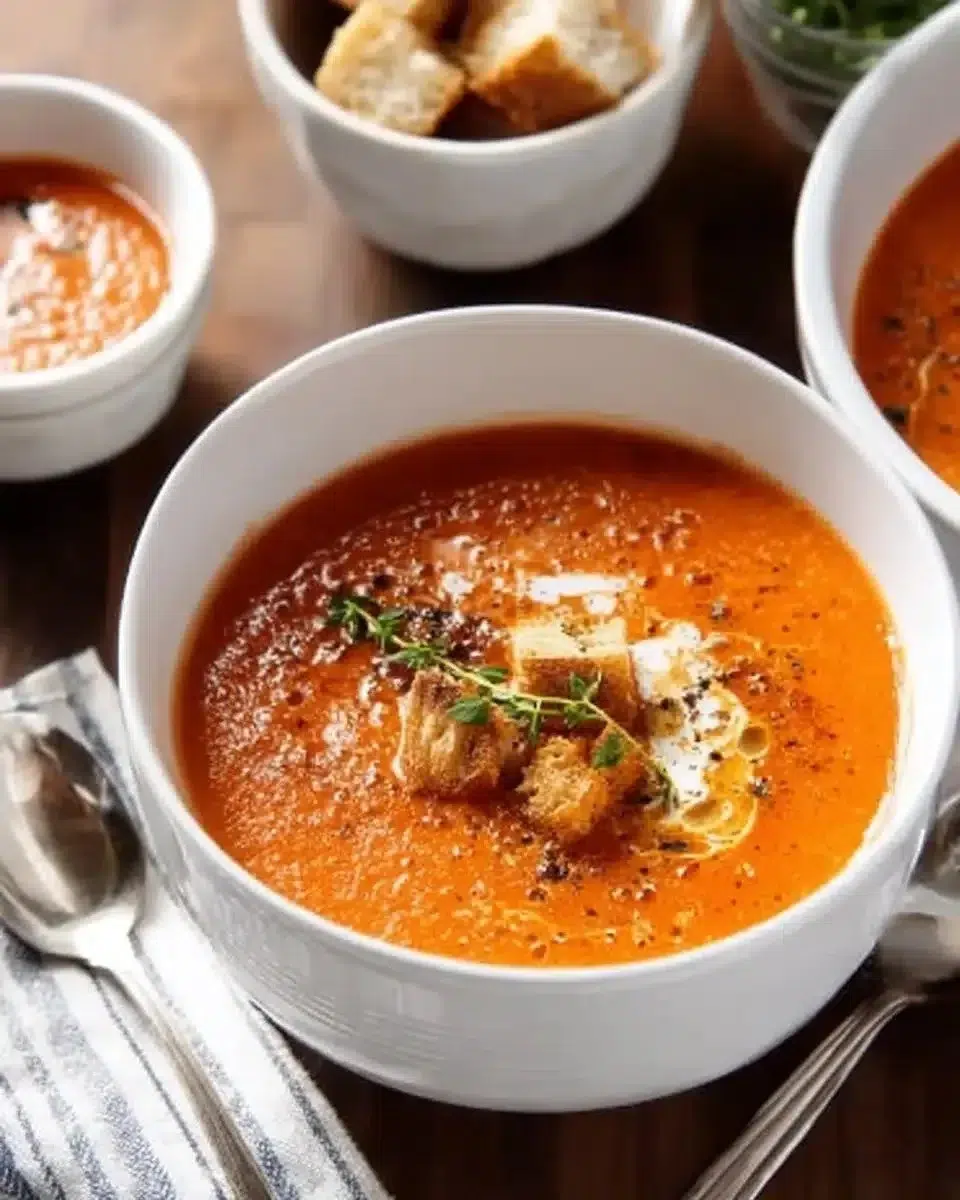
This bowl smells like warm summer tomatoes and buttered toast. Creamy Tomato Soup starts with roasted tomatoes and sautéed aromatics for depth, then finishes with a splash of cream for silk. I developed and tested this recipe across many kitchens and refined it until the texture felt just right — I cooked it eight times to tune seasoning and thickness. It’s the version I relied on for weeknight service at a neighborhood bistro. The method is forgiving, fast, and scales well, so you can make an easy tomato soup for a solo lunch or a cozy family dinner. Read on for the full recipe, tips, and make-ahead options — plus a couple of trusted variations to suit your pantry.
Why This Recipe Works
- Roasting the tomatoes concentrates sweetness and adds caramelized depth without extra sugar.
- Sweating onions and garlic first builds savory flavor through gentle Maillard reactions.
- Blending while hot creates a silky emulsion; adding cream off-heat preserves brightness.
- A small amount of tomato paste and acid (vinegar or lemon) balances sweetness and rounds flavor.
- Finely straining the soup produces a velvety mouthfeel like restaurant soups.
Ingredients Breakdown
- Tomatoes (900 g / 2 lb ripe tomatoes or two 28-oz / 800 g cans whole peeled): The base. Roasting fresh tomatoes deepens flavor; canned is a reliable shortcut.
- Extra-virgin olive oil (45 ml / 3 tbsp): For roasting and flavor. Can substitute neutral oil, but flavor will be milder.
- Yellow onion (150 g / 1 medium): Sweated to sweeten and add savory backbone.
- Garlic (3 cloves): Adds aromatic lift. Do not brown — cook until fragrant only.
- Tomato paste (30 g / 2 tbsp): Adds umami and color; skip it and the soup tastes flatter.
- Vegetable or chicken stock (720 ml / 3 cups): Thins the soup and adds savory notes. Use low-sodium if watching salt.
- Heavy cream (120 ml / 1/2 cup) or whole milk (240 ml / 1 cup) for a lighter version: Cream gives silk; milk lightens calories but reduces richness.
- Sugar (optional, 1–2 tsp / 5–10 g): Use only if tomatoes are very acidic.
- Red wine vinegar or lemon juice (15 ml / 1 tbsp): Brightens and balances sweetness.
- Kosher salt and freshly ground black pepper: Season to taste. If using Morton salt, start with half the kosher amount.
- Fresh basil (optional, small handful): For garnish and a fresh lift.
Substitutions with impact warnings:
- For a dairy-free bowl, swap heavy cream with 120 ml (1/2 cup) full-fat coconut milk — texture will be slightly coconut-forward.
- Use canned tomatoes for speed; flavor will be less bright than roasted fresh tomatoes.
- If you choose a lower-fat milk, the soup will be thinner and less silky.
Essential Equipment
- 1 large roasting pan or rimmed baking sheet for roasting tomatoes.
- 3- to 4-quart (3–4 L) heavy-bottomed pot or Dutch oven — even heat matters to prevent scorching.
- Immersion blender or countertop blender — an immersion blender is the fastest and safest with hot liquids.
- Fine-mesh sieve and ladle for optional straining to achieve a velvety texture.
- Wooden spoon, spatula, and chef’s knife.
- If you lack a sieve, a chinois or food mill is a good substitute for extra smooth results.
Step-by-step Instructions
Active prep takes about 15 minutes, cook time about 35 minutes, inactive time none, and total time roughly 50 minutes; the recipe yields 4 servings (about 1 cup / 240 ml per serving).
Step 1: Roast the Tomatoes
Preheat the oven to 220°C (425°F). Halve 900 g (2 lb) tomatoes, toss with 30 ml (2 tbsp) olive oil, 1 tsp salt, and spread on a rimmed sheet. Roast until edges brown and juices concentrate, 20–25 minutes; the tomatoes should smell sweet and caramelized.
Step 2: Sweat the Aromatics
While tomatoes roast, heat 30 ml (2 tbsp) olive oil in a 3–4 L pot over medium heat. Add 150 g (1 medium) chopped yellow onion and cook until translucent and soft, about 6–8 minutes, stirring every 1 minute. Add 3 minced garlic cloves and sauté 30–45 seconds until fragrant.
Step 3: Build the Base
Stir in 30 g (2 tbsp) tomato paste and cook 1–2 minutes to remove raw flavor. Add the roasted tomatoes and any pan juices, plus 720 ml (3 cups) stock. Bring to a simmer and cook 10 minutes to meld flavors and reduce slightly.
Step 4: Purée the Soup
Use an immersion blender to purée until smooth, about 60–90 seconds, working in short bursts. If using a countertop blender, cool slightly and blend in batches; hold the lid down with a towel to avoid splatter. For the silkiest result, press the puréed soup through a fine-mesh sieve into a clean pot.
Step 5: Finish and Season
Return the strained soup to low heat. Stir in 120 ml (1/2 cup) heavy cream and 15 ml (1 tbsp) red wine vinegar or lemon juice. Warm 2–3 minutes, but do not boil after adding cream. Taste and adjust salt and pepper. If bright acidity is missing, add another 1 tsp vinegar.
Step 6: Serve
Ladle into bowls and garnish with torn basil leaves and a drizzle of olive oil. Optionally serve with grilled cheese or crusty bread. Serve immediately; the texture is best hot.
Expert Tips & Pro Techniques
- Use slightly underripe tomatoes for roasting if you want higher acidity and classic tomato tang. Overripe tomatoes can make the soup sweet and flat.
- Common mistake: boiling after adding cream. Avoid it. Boiling can split the cream and dull brightness; keep the soup at a gentle warm.
- For ultra-silky texture used in restaurants, pass the purée through a fine-mesh sieve or use a food mill. It removes seeds and fibrous bits.
- Make-ahead: The soup holds well refrigerated for up to 3 days. Reheat gently and add cream just before serving for the freshest flavor.
- Professional trick adapted for home cooks: Roast a small shallot or onion alongside the tomatoes for extra caramelized sweetness when you’re short on time.
- To rescue a bland batch, add a pinch of baking soda (very small) to neutralize acidity, then balance with a little extra vinegar — taste as you go.
Storage & Reheating
- Refrigerator: Store in an airtight container up to 3 days. Cool to room temperature before sealing to protect fridge temperature.
- Freezer: This soup freezes well for up to 3 months. Cool completely, leave some headspace, and freeze in freezer-safe containers. Thaw overnight in the fridge.
- Reheating: Reheat gently over low heat, stirring frequently, until steaming (but not boiling), about 6–8 minutes for a 4-cup pot. If frozen, thaw overnight and reheat as above. Avoid high microwaving that can separate fats; if using a microwave, warm in 20–30 second bursts and stir.
Variations & Substitutions
- Dairy-Free Version: Replace 120 ml (1/2 cup) heavy cream with 120 ml (1/2 cup) canned full-fat coconut milk. The soup gains a subtle coconut note. Everything else stays the same.
- Tomato-Basil Focused: Add a large handful of packed basil leaves (about 30 g / 1 cup) to the blender and pulse until just wilted. Keep roasting and cooking times the same. See our basil variation for more ideas: tomato-basil variation.
- Lighter, Yogurt Finish: Use 240 ml (1 cup) whole milk instead of cream and stir in 60–120 g (1/4–1/2 cup) plain Greek yogurt off-heat for tang and protein. Do not boil after adding yogurt.
- Brothy Weeknight Version: Omit cream and add an extra 240 ml (1 cup) stock for a lighter, brothy soup. Increase seasoning and acid slightly.
- Hearty, Protein-Forward: Stir in 200 g (7 oz) cooked shredded chicken or a can of white beans (drained) at the end and simmer 3–4 minutes to heat through.
Serving Suggestions & Pairings
- Classic pairing: Grilled cheese on sourdough or a toasted baguette — the crunchy, buttery bread balances the silky soup. Try pairing with our quick crusty bread recipe: hearty soup companion ideas.
- Light lunch: Serve with a peppery arugula salad dressed in lemon vinaigrette.
- Garnish ideas: Drizzle of basil oil, swirl of crème fraîche, or a few torn basil leaves and cracked black pepper.
- Beverage pairing: A light-bodied red wine (like Beaujolais) or a crisp dry rosé complements acidity and creaminess.
- For a vegetable-forward meal, pair with roasted Brussels sprouts or simple garlic-roasted potatoes: roasted vegetable pairing ideas.
Nutrition Information
Serving size: 1 cup (240 ml). Servings: 4.
Estimated per serving:
- Calories: 220 kcal
- Total Fat: 14 g
- Saturated Fat: 7 g
- Cholesterol: 35 mg
- Sodium: 420 mg
- Total Carbohydrates: 18 g
- Dietary Fiber: 3 g
- Sugars: 10 g
- Protein: 4 g
Nutrition values are estimates. Actual values may vary based on specific ingredients and preparation methods.
Frequently Asked Questions
Q: Why did my soup taste flat?
A: Often it needs acid or salt. Add 1 tsp red wine vinegar or lemon juice and taste. Also ensure you cooked the tomato paste briefly — that deepens flavor.
Q: Can I make this without cream?
A: Yes. Use 240 ml (1 cup) milk or omit dairy altogether and use coconut milk 120 ml (1/2 cup) for a dairy-free finish. Expect a change in richness and flavor.
Q: Can I double this recipe?
A: Yes. Double all ingredients and use a larger pot. Cooking times are the same, though simmer time to meld flavors may increase by 5–10 minutes.
Q: Can I prepare this the night before?
A: Absolutely. Make the soup, cool, and refrigerate. Reheat gently the next day and add fresh cream or yogurt just before serving for best texture.
Q: How long does this keep in the fridge?
A: Stored in an airtight container, it keeps 3 days in the refrigerator. For longer storage, freeze for up to 3 months.
Q: Will the soup separate after reheating?
A: If reheated too quickly or boiled, cream can separate. Warm gently over low heat and stir frequently. If separation happens, a quick whisk and a splash of cold cream can bring it back.
Q: Can I use canned tomatoes instead of fresh?
A: Yes. Swap in two 28-oz (800 g) cans of whole peeled tomatoes. Simmer 10–12 minutes to concentrate flavor and consider a 1–2 tsp sugar if acidity is high. For a deeper taste, briefly sauté canned tomato pieces with tomato paste before adding stock.
Conclusion
This simple, velvety bowl is a reliable weeknight star. For other takes and inspiration, I like to compare techniques and timing from trusted sources like Joy the Baker’s simple and creamy tomato soup and Natasha’s Kitchen easy tomato soup. Those recipes offer helpful variations on roasting and texture if you want to experiment.

Creamy Tomato Soup
- Total Time: 50 minutes
- Yield: 4 servings 1x
- Diet: Vegetarian
Description
A simple, velvety bowl of creamy tomato soup, perfect for a cozy meal, made with roasted tomatoes and a splash of cream.
Ingredients
- 900 g ripe tomatoes or two 28-oz cans whole peeled
- 45 ml extra-virgin olive oil
- 150 g yellow onion, chopped
- 3 cloves garlic, minced
- 30 g tomato paste
- 720 ml vegetable or chicken stock
- 120 ml heavy cream
- 15 ml red wine vinegar or lemon juice
- Kosher salt and freshly ground black pepper, to taste
- Fresh basil, for garnish
- Sugar, optional (1–2 tsp)
Instructions
- Preheat the oven to 220°C (425°F). Halve tomatoes, toss with olive oil, salt, and spread on a sheet. Roast until edges brown, about 20–25 minutes.
- Heat olive oil in a pot over medium heat. Add chopped onion and cook until translucent, about 6–8 minutes. Stir in minced garlic and sauté until fragrant.
- Stir in tomato paste and cook for 1–2 minutes. Add roasted tomatoes and stock, then bring to a simmer and cook for 10 minutes.
- Purée the soup using an immersion blender until smooth. If using a countertop blender, cool slightly before blending.
- Return the strained soup to low heat. Stir in heavy cream and vinegar or lemon juice, warming gently but do not boil.
- Ladle into bowls, garnish with basil and a drizzle of olive oil. Serve immediately.
Notes
For a dairy-free version, substitute heavy cream with coconut milk. Make-ahead: The soup can be refrigerated for up to 3 days.
- Prep Time: 15 minutes
- Cook Time: 35 minutes
- Category: Soup
- Method: Roasting & Blending
- Cuisine: Italian
Nutrition
- Serving Size: 1 cup (240 ml)
- Calories: 220
- Sugar: 10g
- Sodium: 420mg
- Fat: 14g
- Saturated Fat: 7g
- Unsaturated Fat: 4g
- Trans Fat: 0g
- Carbohydrates: 18g
- Fiber: 3g
- Protein: 4g
- Cholesterol: 35mg

Written by Sadka
Sadka is the founder and editor-in-chief of Al3abFun. Passionate about making delicious food accessible to everyone, Sadka oversees recipe development, nutritional accuracy, and editorial quality across all published content. With a background in food science and digital publishing, Sadka ensures every recipe meets the highest standards of taste, accuracy, and presentation.