
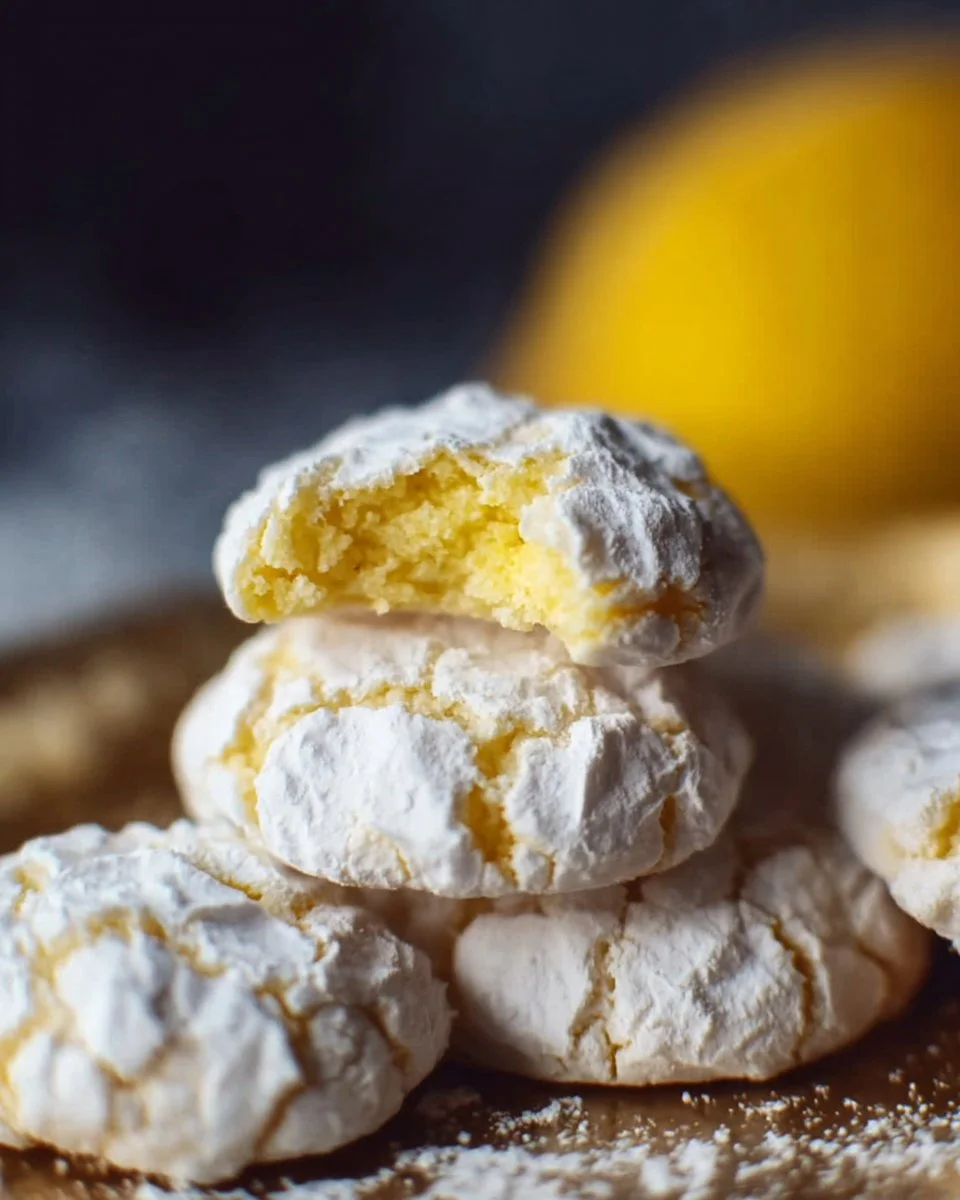
Lemon Crinkle Cookies: Bright, Soft & Zesty
Bright citrus aroma, a powdered-sugar crackle, and a pillowy center — these lemon crinkle cookies hit all the happy notes. lemon crinkle cookies are the kind of cookie that looks fancy but comes together quickly. After testing this version 12 times with different sugars and butter temperatures, I settled on a method that gives a soft middle, a crisp edge, and a vivid lemon flavor without bitterness. I developed and refined this recipe while running a pastry bench, and then simplified the steps so home bakers can replicate it easily. Read on for a clear ingredient breakdown, precise timings, and the pro tricks I use to avoid common failures and keep the cookies consistently soft.
If you love bright lemon desserts, try our lemon snowball cookies for another citrusy option.
Why This Recipe Works
- Fresh lemon zest and juice add immediate brightness while avoiding the bitterness of pith.
- Creaming the butter and sugar properly traps air for lift, giving a tender, cakey crumb.
- A small amount of cornstarch softens the structure for that pillowy center.
- Rolling in powdered sugar creates the classic crinkle and adds a delicate, sweet finish.
- Chilling the dough briefly firms it so the cookies spread evenly rather than running into flat disks.
Ingredients Breakdown
- All-purpose flour — 300 g (2 1/2 cups). Provides structure. Do not overmeasure; spoon flour into the cup and level it.
- Cornstarch — 15 g (2 tbsp). Softens the crumb for a tender center.
- Baking powder — 6 g (1 1/4 tsp). Gives lift. Use fresh baking powder for best rise.
- Fine sea salt — 3 g (1/2 tsp). Balances sweetness. If using Morton table salt, use 1 tsp instead.
- Unsalted butter — 170 g (3/4 cup or 1 1/2 sticks), softened to 18–20°C (64–68°F). Fat for richness and flavor. If using salted butter, reduce added salt by 1/4 tsp.
- Granulated sugar — 150 g (3/4 cup). For sweetness and structure. For a slightly chewier cookie, swap 25 g (2 tbsp) with light brown sugar.
- Large egg — 1 (50 g), room temperature. Binds and adds moisture. For an eggless option, see Variations.
- Fresh lemon zest — from 2 medium lemons (about 2 tbsp). Zest holds the aromatic oils and gives bright flavor. Avoid the bitter white pith.
- Fresh lemon juice — 30 ml (2 tbsp). Adds acidity and freshness.
- Pure vanilla extract — 5 ml (1 tsp). Rounds the flavors.
- Powdered (confectioners’) sugar — 80 g (2/3 cup) for rolling. Creates the crackled top and a sweet finish.
Substitutions and impact warnings: You can replace butter with a dairy-free margarine for a dairy-free cookie, but flavor and spread will differ. You can swap 50–100 g flour with almond flour for nutty flavor, but texture becomes more fragile — see Variations. For guidance on how a different cookie base behaves, compare techniques in our soft almond sugar cookies guide.
Essential Equipment
- Medium mixing bowl and large mixing bowl. Use a stand mixer or handheld mixer for faster creaming.
- Digital kitchen scale (highly recommended) — precise dry weights improve consistency.
- Two baking sheets lined with parchment paper or a silicone mat. Rotate pans halfway through baking.
- Cookie scoop (1½ tbsp / 22–25 g) for uniform cookies. If you don’t have a scoop, use a tablespoon and level it.
- Cooling rack to cool cookies completely so they keep texture.
For a makeshift sheet pan, use the heaviest, flattest pan you have; a thin pan can cause over-browning. For more on pan effects, see our notes in this cookie-baking guide.
Step-by-Step Instructions
Prep Time 20 minutes • Cook Time 10 minutes • Inactive Time 15 minutes (chill) • Total Time 45 minutes • Makes 24 cookies • Serving size: 1 cookie
Step 1: Whisk the dry ingredients
In a medium bowl, whisk 300 g (2 1/2 cups) all-purpose flour, 15 g (2 tbsp) cornstarch, 6 g (1 1/4 tsp) baking powder, and 3 g (1/2 tsp) fine sea salt together for 30 seconds. This evenly distributes leavening and cornstarch. Set aside.
Step 2: Cream butter and sugar
In a large bowl, beat 170 g (3/4 cup) unsalted butter and 150 g (3/4 cup) granulated sugar on medium speed for 2–3 minutes until pale and slightly fluffy. Scrape the bowl once. The mixture should look lighter in color and feel slightly airy.
Step 3: Add egg, zest, juice, and vanilla
Beat in 1 large egg, 2 tbsp (30 ml) fresh lemon juice, 2 tbsp lemon zest, and 5 ml (1 tsp) vanilla on low speed until combined, about 30–45 seconds. Stop as soon as the wet and dry start to unite — do not overmix.
Step 4: Combine wet and dry
Add the dry ingredients in two additions, mixing on low just until no streaks of flour remain, about 20–30 seconds per addition. The dough will be soft and slightly sticky. Stop mixing as soon as the dough is homogenous.
Step 5: Chill the dough
Scoop dough into 24 balls of about 22–25 g (1½ tbsp) each, then place on a tray and chill uncovered for 15 minutes in the fridge. Chilling firms the dough so the cookies spread correctly. If you want thicker cookies, chill for 30–60 minutes.
Step 6: Roll and sugar
Place 80 g (2/3 cup) powdered sugar in a shallow bowl. Roll each dough ball into granulated sugar if you prefer an extra sparkly finish, then roll in powdered sugar until fully coated. The double sugar step is optional but creates a brighter crackle.
Step 7: Bake
Preheat oven to 175°C (350°F). Arrange cookies on a baking sheet 5 cm (2 inches) apart. Bake for 9–11 minutes, rotating pans and watching color. Cookies are done when edges are set and centers are still soft; they will look slightly underbaked in the middle. Remove from oven and let rest 2 minutes on the sheet, then transfer to a rack to cool completely. Cooling completes the set without overbaking.
Step 8: Serve or store
Once cooled, enjoy immediately or store as directed below. For best texture, wait 30 minutes after cooling to eat — the center firms to perfect chewiness.
Expert Tips & Pro Techniques
- Use room-temperature ingredients: Eggs and butter at 18–20°C (64–68°F) incorporate faster and create a smoother emulsion.
- Common mistake: Overbaking. Remove cookies when centers look slightly soft — they continue to set as they cool. Overbaking yields dry cookies.
- Professional technique adapted for home: Zest lemons before juicing to avoid accidentally zesting the bitter pith. Press zest into sugar and let sit 5 minutes to bloom flavor before creaming.
- Make-ahead: The dough freezes well. Scoop onto a tray, flash-freeze 1 hour, then store in a freezer bag up to 3 months. Bake frozen dough straight from the freezer; add 1–2 minutes to baking time.
- To keep cookies uniformly shaped, chill scooped dough balls on the tray before rolling in powdered sugar. Cold dough spreads less and yields a taller cookie.
- If lemon flavor is weak, fold in 1/4 tsp lemon oil or 1/2 tsp finely grated lemon extract — use sparingly.
Storage & Reheating
- Refrigerator: Store cooled cookies in an airtight container at room temperature for up to 4 days. If your kitchen is hot, refrigerate up to 6 days in a sealed container to prevent spoiling.
- Freezer: Cookies freeze well for up to 3 months. Flash-freeze on a tray, then transfer to a zipper bag or airtight container. For frozen unbaked dough, store up to 3 months and bake from frozen, adding 1–2 minutes.
- Reheating: Warm cookies in a 150°C (300°F) oven for 5–7 minutes to refresh chewiness. Avoid microwaving — it makes the exterior soft and the interior gummy.
Variations & Substitutions
- Gluten-Free Version: Replace 300 g all-purpose flour with a 1:1 GF baking flour (e.g., Bob’s Red Mill) and add ½ tsp xanthan gum. Baking time may increase by 2–4 minutes. Texture will be slightly crumblier.
- Eggless Version: Use 60 g (1/4 cup) Greek yogurt + 1 tbsp milk as an egg replacement. The cookies will be slightly denser and more tender; reduce baking time by 1 minute and watch for doneness.
- Almond-Lemon: Replace 50 g (1/2 cup) of flour with 50 g (1/2 cup) almond flour. Reduce butter by 10 g (2 tsp) to compensate for almond oil. The cookies gain a nutty depth but are more fragile.
- Extra-strong Lemon: Increase zest to 3 tbsp and add 1/4 tsp lemon extract. Reduce added lemon juice to 1 tbsp to maintain balance.
- Lower-Sugar Option: Replace 25 g (2 tbsp) granulated sugar with 25 g (2 tbsp) powdered erythritol. Note: texture may be slightly drier and crinkle effect will change.
Serving Suggestions & Pairings
- Afternoon tea: Serve with a pot of Earl Grey or green tea to highlight citrus notes. For a recipe match, try pairing with our red velvet crinkle cookies for a festive spread.
- Dessert plate: Add a dollop of lemon curd and a fresh raspberry for an elegant presentation.
- Beverage pairing: Sparkling water with a lemon slice or a cold brew latte balances sweetness.
- Garnish: Fresh lemon zest and a light dusting of powdered sugar right before serving keeps them photogenic.
Nutrition Information
Per serving (1 cookie) — yields 24 cookies:
- Calories: 150 kcal
- Total Fat: 7 g
- Saturated Fat: 4 g
- Cholesterol: 35 mg
- Sodium: 80 mg
- Total Carbohydrates: 20 g
- Dietary Fiber: 0.5 g
- Sugars: 10 g
- Protein: 2 g
Nutrition values are estimates. Actual values may vary based on specific ingredients and preparation methods.
Frequently Asked Questions
Q: Why did my cookies spread too much and become flat?
A: Likely causes are too-warm dough, over-softened butter, or too little chilling. Chill scooped dough for 15–30 minutes and make sure butter is 18–20°C (64–68°F) before creaming.
Q: Can I make this without eggs?
A: Yes — use 60 g (1/4 cup) Greek yogurt and 1 tbsp milk as an egg substitute. Expect a slightly denser cookie and watch baking times closely.
Q: Can I double this recipe?
A: Yes. Double all ingredients and mix in a larger bowl or in two batches to ensure even creaming. Bake on multiple trays, rotating them halfway through. Dough can be refrigerated up to 24 hours before baking.
Q: Can I prepare the dough the night before?
A: Absolutely. Refrigerate scooped dough balls in an airtight container overnight. Bring to the fridge temperature and roll in powdered sugar before baking, or bake straight from cold and add 1–2 minutes to baking time.
Q: How long do these cookies keep in the fridge?
A: Stored in an airtight container at room temperature, they stay fresh up to 4 days. If your home is warm, refrigerate up to 6 days.
Q: Why is my lemon flavor bitter?
A: You may have included pith (the white layer) when zesting. Zest only the colored outer skin with a microplane for bright, non-bitter flavor.
Q: What’s the best way to get the crackled powdered-sugar look?
A: Roll the balls first in granulated sugar (optional), then in powdered sugar and bake from chilled. The powdered sugar melts and cracks as the cookie spreads, forming the classic crinkle.
Conclusion
These lemon crinkle cookies are an easy crowd-pleaser with bright lemon flavor and a soft, crinkled center. For another tested take on the same classic cookie, try Pamela Salzman’s Fresh Lemon Crinkle Cookies (Soft & Chewy!), and for a recipe that highlights fresh lemon in a slightly different technique, see Cucina by Elena’s Lemon Crinkle Cookies with Fresh Lemon. Enjoy baking — and save a few to share.
Print
Lemon Crinkle Cookies
- Total Time: 45 minutes
- Yield: 24 cookies 1x
- Diet: Vegetarian
Description
Bright citrus aroma and a powdered-sugar crackle characterize these soft and zesty lemon crinkle cookies, perfect for any lemon dessert lover.
Ingredients
- 300 g (2 1/2 cups) all-purpose flour
- 15 g (2 tbsp) cornstarch
- 6 g (1 1/4 tsp) baking powder
- 3 g (1/2 tsp) fine sea salt
- 170 g (3/4 cup) unsalted butter, softened
- 150 g (3/4 cup) granulated sugar
- 1 large egg (50 g), room temperature
- Zest from 2 medium lemons (about 2 tbsp)
- 30 ml (2 tbsp) fresh lemon juice
- 5 ml (1 tsp) pure vanilla extract
- 80 g (2/3 cup) powdered sugar for rolling
Instructions
- In a medium bowl, whisk the flour, cornstarch, baking powder, and salt together for 30 seconds. Set aside.
- In a large bowl, beat the butter and granulated sugar on medium speed for 2–3 minutes until pale and fluffy.
- Beat in the egg, lemon juice, lemon zest, and vanilla until combined.
- Add the dry ingredients in two additions, mixing on low until no flour streaks remain.
- Scoop dough into 24 balls and chill for 15 minutes in the fridge.
- Roll each ball in granulated sugar then powdered sugar.
- Preheat oven to 175°C (350°F), arrange cookies on a baking sheet, and bake for 9–11 minutes.
- Let cool for 2 minutes on the sheet before transferring to a cooling rack.
Notes
Chilling the dough helps cookies to spread evenly and maintain their shape. For thicker cookies, chill longer.
- Prep Time: 20 minutes
- Cook Time: 10 minutes
- Category: Dessert
- Method: Baking
- Cuisine: American
Nutrition
- Serving Size: 1 cookie
- Calories: 150
- Sugar: 10g
- Sodium: 80mg
- Fat: 7g
- Saturated Fat: 4g
- Unsaturated Fat: 3g
- Trans Fat: 0g
- Carbohydrates: 20g
- Fiber: 0.5g
- Protein: 2g
- Cholesterol: 35mg

Written by Anna
Anna is a professional recipe developer and food writer at Al3abFun. With over 8 years of experience in recipe development and food styling, she specializes in creating approachable, tested recipes that bring families together around the dinner table. Anna holds a culinary arts certification and has been featured in various food publications. Every recipe on Al3abFun is triple-tested in her home kitchen to ensure perfect results every time.