
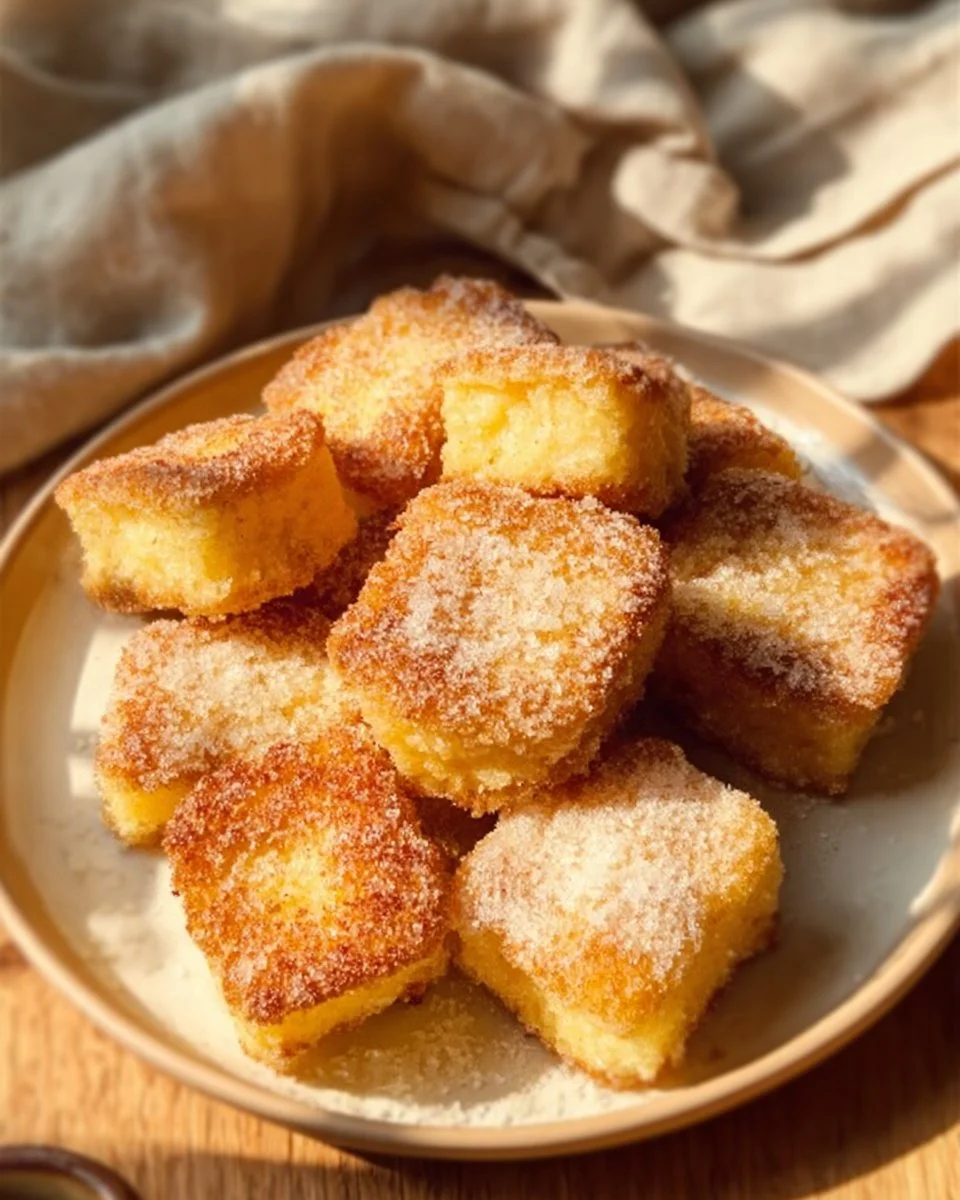
Fried Milk (Leche Frita) — Crispy Spanish Dessert
The first bite is a contrast: a warm, crisp shell giving way to a silky, cinnamon-scented center — this is fried milk in its simplest glory. I developed and refined this recipe over eight test runs until the custard set firm but remained tender, and the crust stayed crunchy for minutes. This version leans on cornstarch for a satiny texture and day-old breadcrumbs for a light, craggy crust. It’s an approachable Spanish dessert that cooks quickly and rewards careful chilling. If you like the idea of fried, custardy treats, try pairing it with dulce de leche (we often link to a rich dulce de leche alfajores recipe for inspiration). Read on for exact measurements, step-by-step timing, and pro tips to avoid a gummy center or soggy crust.
Why This Recipe Works
- Cornstarch plus a small amount of flour gives a glossy, stable custard that cuts cleanly yet remains tender.
- Boiling the milk with lemon peel and cinnamon infuses flavor without adding moisture that weakens the set.
- Rapid chilling firms the custard so it can be sliced and breaded without falling apart.
- Double dredging (flour → egg → breadcrumbs) creates a strong barrier that keeps oil out and gives an even golden color.
- Resting the cut pieces on a rack releases surface moisture and prevents a soggy crust when frying.
Ingredients Breakdown
- Whole milk 1,000 ml (4 cups): The base for flavor and mouthfeel. Do not use skim — it yields a thin, weak custard. You may use 2% for a slightly lighter result.
- Granulated sugar 120 g (½ cup): Sweetens and helps set the custard. Reduce by 25 g (2 tbsp) if you prefer less sweet.
- Cornstarch 120 g (1 cup) + all-purpose flour 30 g (¼ cup): Cornstarch is the main thickener; flour adds structure to help the custard hold shape. Replacing all cornstarch with flour will make the texture grainy.
- Unsalted butter 30 g (2 tbsp): Adds silkiness. Salted butter is fine; omit added table salt if using it.
- 1 large egg + 1 large egg yolk (for custard): The egg yolk enriches and aids thickening. If you must avoid eggs, see substitutions below (will change texture).
- Lemon zest from 1 lemon and 1 small cinnamon stick: Aromatics that lift the flavor. Do not add liquid lemon juice — acid can interfere with setting.
- Fine sea salt 2 g (½ tsp): Balances sweetness. If using Morton kosher salt, increase to ¾ tsp.
- For coating: 100 g (1 cup) plain all-purpose flour; 2 large eggs beaten (for dredge); 120 g (1½ cups) fresh or day-old breadcrumbs. Panko works well for extra crunch.
- Neutral frying oil (vegetable or peanut) — enough for 3–4 cm (1¼–1½ in) deep frying: Use an oil with a high smoke point.
Essential Equipment
- Medium heavy-bottomed saucepan (2–3 L): Gives even heat so the custard won’t scorch.
- Whisk and wooden spoon: Whisk to dissolve starch, spoon to stir while cooking.
- 9×13-inch (23×33 cm) shallow pan or loaf pan: Use this size so the custard sets about 2–3 cm (¾–1¼ in) thick; a deeper pan will need longer chill time.
- Plastic wrap or parchment to cover surface: Prevents a skin forming.
- Sharp knife and bench scraper: For neat cutting.
- Wire cooling rack with tray beneath: Drains and cools pieces after breading.
- Deep skillet or heavy pot for frying (min 20 cm / 8 in diameter): A smaller pot keeps oil depth consistent.
- Candy or instant-read thermometer: Keeps oil at a steady 175°C (350°F).
- Fine-mesh sieve (optional): For smoothing the custard before chilling.
Step-by-Step Instructions
Prep time 20 minutes, Cook time 20 minutes, Inactive time 2 hours chilling, Total time 2 hours 40 minutes, Servings 6 (1 piece each).
Step 1: Infuse the milk
Pour 1,000 ml (4 cups) whole milk into a medium saucepan with the peel of 1 lemon and 1 small cinnamon stick; bring to a bare simmer over medium heat, about 5–7 minutes, stirring occasionally so milk does not scorch. Remove from heat and let steep for 10 minutes for a pronounced aroma. Strain and discard aromatics before returning milk to the pan.
Step 2: Whisk the dry mix
In a bowl, whisk together 120 g (1 cup) cornstarch, 30 g (¼ cup) all-purpose flour, 120 g (½ cup) granulated sugar, and 2 g (½ tsp) sea salt until homogeneous. This ensures even thickening and no lumps when liquid is added.
Step 3: Make the custard
Return 750 ml (3 cups) of the warm milk to the saucepan and reserve the rest for dilution; gradually whisk the dry mix into the warm milk until smooth. Whisk in 1 large egg and 1 large egg yolk. Add 30 g (2 tbsp) unsalted butter. Cook over medium-low heat, whisking constantly for 6–8 minutes, until the mixture thickens to a thick pudding that coats the back of a spoon and starts to bubble gently. Keep whisking — do not let it boil vigorously or you’ll get lumps.
Step 4: Finish and chill
Pour the hot custard into a 9×13-inch (23×33 cm) pan lined with plastic wrap so the wrap touches the surface; this prevents a skin. Smooth the top and press plastic against the custard. Chill in the fridge for at least 2 hours, or until fully firm.
Step 5: Cut and rest
Turn the chilled custard onto a cutting board and slice into 6 equal rectangles, about 2.5–3 cm (1 in) thick. Place pieces on a wire rack and refrigerate uncovered for 15–30 minutes to dry the surface — this helps the coating stick. Resting also reduces moisture that makes the crust soggy.
Step 6: Set up breading station
Arrange 100 g (1 cup) all-purpose flour in one shallow dish, 2 beaten large eggs in another, and 120 g (1½ cups) breadcrumbs in a third. Dredge each piece in flour, shake off excess, dip in egg, then press into breadcrumbs. For best adhesion, repeat the egg and breadcrumb step once for a double crust. Double coating gives the crispiest shell.
Step 7: Fry until golden
Heat neutral oil in a deep skillet to 175°C (350°F); use enough oil to cover half the thickness of the pieces (about 3–4 cm / 1¼–1½ in). Fry in batches for 1½–2 minutes per side, turning once, until deep golden and crisp. Total fry time per piece is about 3–4 minutes. Remove to a wire rack; drain briefly and serve warm.
Expert Tips & Pro Techniques
- Common mistake: frying too hot. If oil is above 180°C (356°F), the crust browns before the center warms — keep oil at 170–175°C (340–350°F).
- Use day-old breadcrumbs or lightly toast fresh crumbs for better texture and less oil absorption.
- Make-ahead: the custard can be made and chilled up to 48 hours ahead; keep covered and crumb immediately before frying for best texture.
- Professional trick for a firmer shape: after slicing, freeze pieces for 20–30 minutes so the crust sets faster and the interior remains cool while frying.
- Avoid overcrowding the pan; frying too many pieces at once lowers the oil temperature and gives greasy results.
- For an evenly shiny custard, push the custard through a fine sieve before chilling to remove any bits of cooked egg or starch.
Storage & Reheating
- Refrigerator: Store fried pieces in an airtight container for up to 2 days. Place paper towel under pieces to absorb any oil.
- Freezer: Not recommended after frying; the crust will become limp when thawed. You can freeze the uncooked, breaded pieces on a tray for up to 1 month; flash-freeze, then transfer to a sealed bag. Fry from frozen, adding 30–60 seconds per side.
- Reheating: Reheat in a 175°C (350°F) oven for 6–8 minutes to restore crispness. Avoid microwaving — it makes the crust soggy.
Variations & Substitutions
- Gluten-Free Version: Replace 100 g (1 cup) all-purpose flour in the custard with 100 g (1 cup) cornstarch total and use a 1:1 GF flour for dredging; add ½ tsp xanthan gum for better structure. Frying time unchanged.
- Dairy-Free Option: Use full-fat coconut milk (1,000 ml) instead of whole milk and replace butter with 2 tbsp coconut oil. Flavor will be coconut-forward; reduce coconut oil by 1 tbsp for a less oily finish.
- Chocolate-Citrus Twist: Whisk 30 g (¼ cup) cocoa powder into the dry mix and add 1 tsp orange zest. Cocoa slightly increases bitterness; add 15 g (1 tbsp) extra sugar if desired.
- Baked Alternative: For a lower-fat version, brush breaded pieces with oil and bake at 200°C (400°F) for 12–15 minutes, flipping halfway, until golden. The crust will be crisper but less uniform than frying.
Serving Suggestions & Pairings
- Serve warm with a drizzle of dulce de leche or a spoonful of thick Greek yogurt for tang. You can reference a rich dulce de leche pairing like our dulce de leche alfajores recipe.
- Dust with powdered sugar and a pinch of ground cinnamon; pair with strong coffee or espresso for contrast.
- For a festive plate, add macerated berries and a mint sprig for brightness.
- For a savory-sweet course, serve alongside a small fried-citrus salad; techniques similar to shallow-frying appear in our vaca frita frying guide.
Nutrition Information (per serving)
Serving size: 1 piece — Recipe yields 6 servings.
- Calories: 390 kcal
- Total Fat: 18 g
- Saturated Fat: 9 g
- Cholesterol: 65 mg
- Sodium: 170 mg
- Total Carbohydrates: 52 g
- Dietary Fiber: 1 g
- Sugars: 33 g
- Protein: 7 g
Nutrition values are estimates. Actual values may vary based on specific ingredients and preparation methods.
Frequently Asked Questions
Q: Why did my fried milk turn out gummy?
A: Gummy custard usually means the custard didn’t cook long enough to fully activate the starches. Cook until it thickly coats the spoon and bubbles gently for 6–8 minutes. Also, over-thickening can happen if you cook on too-high heat; keep it steady and whisk constantly.
Q: Can I make this without eggs?
A: Yes — omit the eggs and increase cornstarch by 15–20 g (1–2 tbsp). The texture will be slightly less rich and more gelatinous, but still tasty.
Q: Can I double this recipe?
A: You can double the ingredients, but use a larger pan or two pans so the custard sets no thicker than 3 cm (1¼ in). Chilling time may increase slightly. Fry in smaller batches to keep oil temperature steady.
Q: Can I prepare this the night before?
A: Absolutely. Make the custard and chill it covered for up to 48 hours. Slice and bread just before frying for the best crust. If breading ahead, keep pieces chilled and fry from cold.
Q: How long does this keep in the fridge?
A: Fried milk keeps well in the fridge for up to 2 days in an airtight container. The crust softens over time; reheat in a 175°C (350°F) oven for best results.
Q: What’s the best oil for frying?
A: Use a neutral oil with a high smoke point, such as vegetable or peanut oil. Olive oil has too low a smoke point and imparts flavor.
Q: My crust falls off while frying. What did I do wrong?
A: The most common reason is too-wet surfaces or not enough rest after breading. Chill pieces on a rack for 15–30 minutes before frying. Also, press breadcrumbs firmly during the second coating and keep oil at 170–175°C (340–350°F) so crust sets quickly.
Conclusion
This fried milk recipe yields a classic Spanish dessert with a silky center and a satisfyingly crisp shell. For a traditional take and alternate methods, the Spruce Eats offers a helpful Spanish leche frita dessert recipe. For historical context and variations across regions, see the Leche frita Wikipedia entry.
Print
Fried Milk (Leche Frita)
- Total Time: 160 minutes
- Yield: 6 servings 1x
- Diet: Vegetarian
Description
Crispy Spanish dessert with a silky, cinnamon-scented center, perfect for fried treat lovers.
Ingredients
- 1,000 ml (4 cups) whole milk
- 120 g (½ cup) granulated sugar
- 120 g (1 cup) cornstarch
- 30 g (¼ cup) all-purpose flour
- 30 g (2 tbsp) unsalted butter
- 1 large egg
- 1 large egg yolk
- Zest of 1 lemon
- 1 small cinnamon stick
- 2 g (½ tsp) fine sea salt
- 100 g (1 cup) all-purpose flour (for coating)
- 2 large eggs (beaten, for dredge)
- 120 g (1½ cups) fresh or day-old breadcrumbs
- Neutral frying oil (vegetable or peanut)
Instructions
- Pour the milk into a saucepan with the lemon peel and cinnamon stick; heat until a simmer, then let steep.
- Whisk together cornstarch, flour, sugar, and salt in a bowl until smooth.
- Return warm milk to saucepan, add dry mix, egg, yolk, and butter. Whisk and cook until thick.
- Pour hot custard into a lined pan, smooth the top, and chill in the fridge for at least 2 hours.
- Turn the custard onto a cutting board and slice into rectangles, then rest pieces on a rack.
- Arrange flour, beaten eggs, and breadcrumbs in shallow dishes; dredge each piece for double coating.
- Heat oil in a deep skillet to 175°C (350°F) and fry pieces until golden, about 3–4 minutes.
Notes
For best texture, use day-old breadcrumbs and avoid overcrowding while frying.
- Prep Time: 20 minutes
- Cook Time: 20 minutes
- Category: Dessert
- Method: Frying
- Cuisine: Spanish
Nutrition
- Serving Size: 1 piece
- Calories: 390
- Sugar: 33g
- Sodium: 170mg
- Fat: 18g
- Saturated Fat: 9g
- Unsaturated Fat: 6g
- Trans Fat: 0g
- Carbohydrates: 52g
- Fiber: 1g
- Protein: 7g
- Cholesterol: 65mg